The 2026 AI Index Report
Stanford HAI 2026 Report: AI is transforming the job market. Check the data on productivity leaps, the junior market crisis, and challenges for individual sectors.
The Stanford HAI AI Index Report 2026 brings extremely clear, hard-data-driven conclusions regarding the impact of artificial intelligence on the labor market. It shows that we have entered a phase of real AI impact on employment and productivity, bringing phenomena never observed before.
Here are the key labor market takeaways from the 2026 report:
1. The 22-to-25 Paradox
The most striking and new trend in the labor market is that productivity gains driven by AI have begun to negatively impact the employment of people entering the labor market (entry-level).
This is perfectly visible in the software development industry (where productivity gains from AI are most measurable).
Data from the report shows that in the United States alone, employment of software developers aged 22–25 fell by nearly 20% since 2024. At the same time, the overall number of employed older, more experienced developers continued to grow. Companies using AI need fewer juniors, as experienced workers supported by AI are able to perform significantly more work on their own.
2. Leap in Productivity
Artificial intelligence is bringing huge gains in labor productivity, but they are distributed unevenly – working best in structured, measurable tasks:
Software Development: Productivity increase of 26%.
Customer Support: Efficiency increase of 14% to 15%.
Marketing: Generated outcomes and productivity in the marketing sector increased by as much as 50%.
Threat: The report points to a new risk – relying too deeply and uncritically on AI at work can carry long-term consequences in the form of slower development of one's own professional skills and critical thinking among employees.
3. Mass Business Adoption
The use of AI in organizations has ceased to be an experiment and has become an operational standard. The adoption rate of AI tools in surveyed enterprises globally reached as high as 88% (up from 78% in the previous year). These tools are being deployed en masse to optimize costs and increase the operational capacity of teams.
4. A Huge Divide in the Perception of the Future of Work (Experts vs. General Public)
The report reveals a gigantic 50-point gap (known as the great perception divide) between how technology specialists view the future of the labor market and how the rest of society sees it:
73% of AI experts believe that artificial intelligence will have a positive impact on how people perform their work.
Meanwhile, only 23% of the public shares this optimism.
More than two-thirds of Americans (64%) expect that within the next 20 years, AI will lead to an overall reduction in the number of jobs (among experts, only 39% share this pessimism).
Experts also project a much faster pace of change: they predict that by 2030, generative AI will support as much as 80% of all hours worked in the US (whereas public forecasts assumed only 10%).
5. Shifts in Talent Acquisition Structure
Decline in US Attractiveness: Despite its financial dominance, the United States is losing its ability to attract global talent. The number of foreign AI researchers and developers moving to the US has dropped by 89% since 2017, with a drastic (as much as 80-percent) decline recorded in the last year alone.
PhD Graduates Choose Academia: The number of new PhDs in the field of AI in the US and Canada grew by 22% (years 2022–2024). Interestingly, unlike in previous years, almost all of this growth went to the academic sector and universities, rather than private tech corporations.
Polish Employee Profile: High Awareness, Low Anxiety
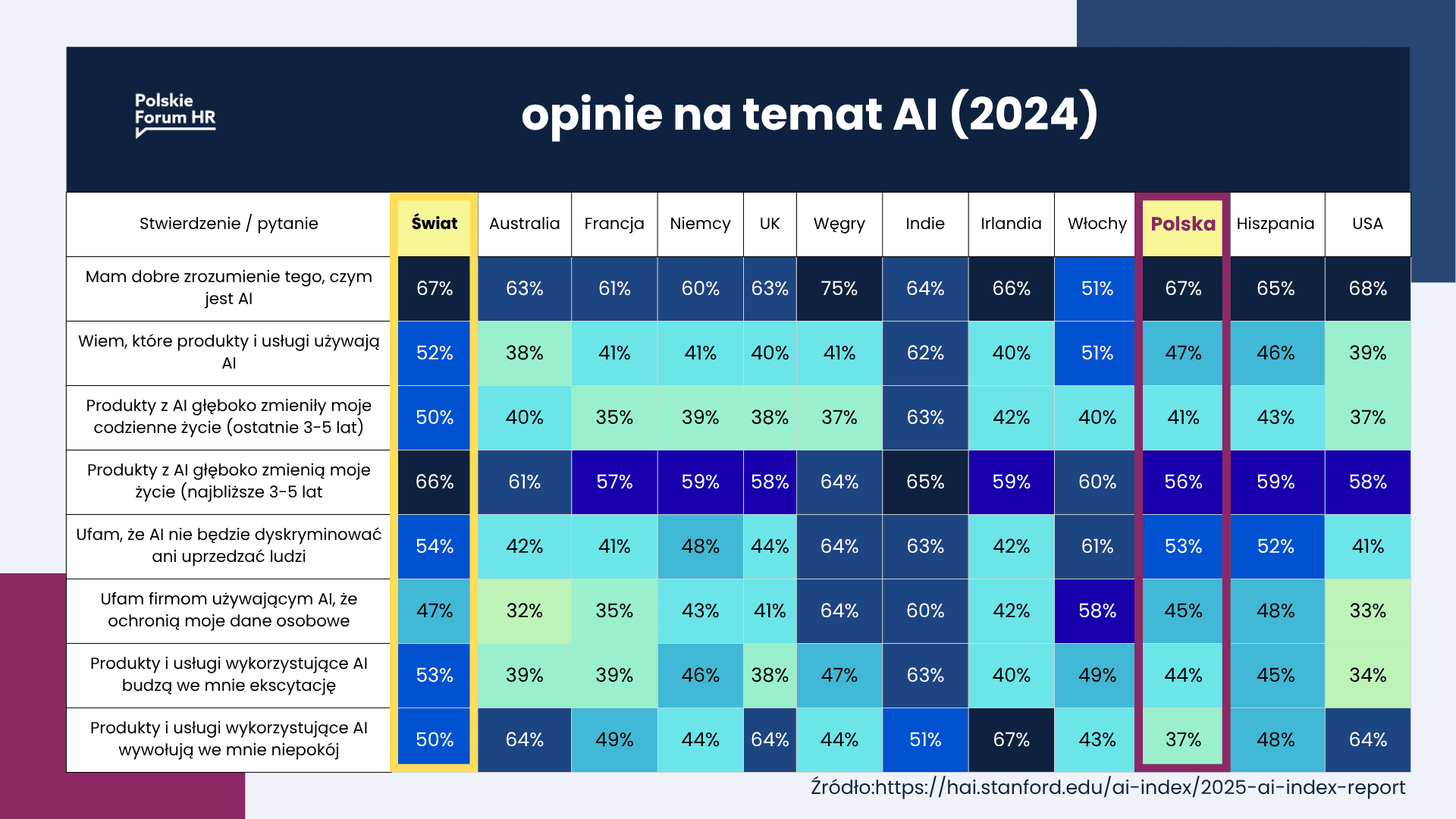
Data from the "Views on AI" chart shows that the Polish employee is entering the era of mass AI adoption with a unique attitude:
Very Good Understanding of the Basics: As many as 67% of Poles declare that they understand well what artificial intelligence is. This result is perfectly equal to the world average (67%) and higher than in many Western European countries (Germany – 60%, France – 61%).
Resilience to Panic (Low Anxiety): What is extremely important in the context of HR, only 37% of Poles declare that products and services using AI cause them concern. This is one of the lowest results among the surveyed countries (for comparison: in the US it is 64%, in the UK 64%, and the world average is 50%).
Pragmatic Approach: Poles are less likely than the rest of the world to believe that AI has already deeply changed their daily lives (41% vs 50% in the world), but more than half (56%) are aware that such a deep change will occur in the next 3–5 years.
For HR departments in Poland, this is excellent news: the Polish team does not fear technology and approaches it without emotional resistance, which dramatically facilitates implementation processes (change management) and upskilling.
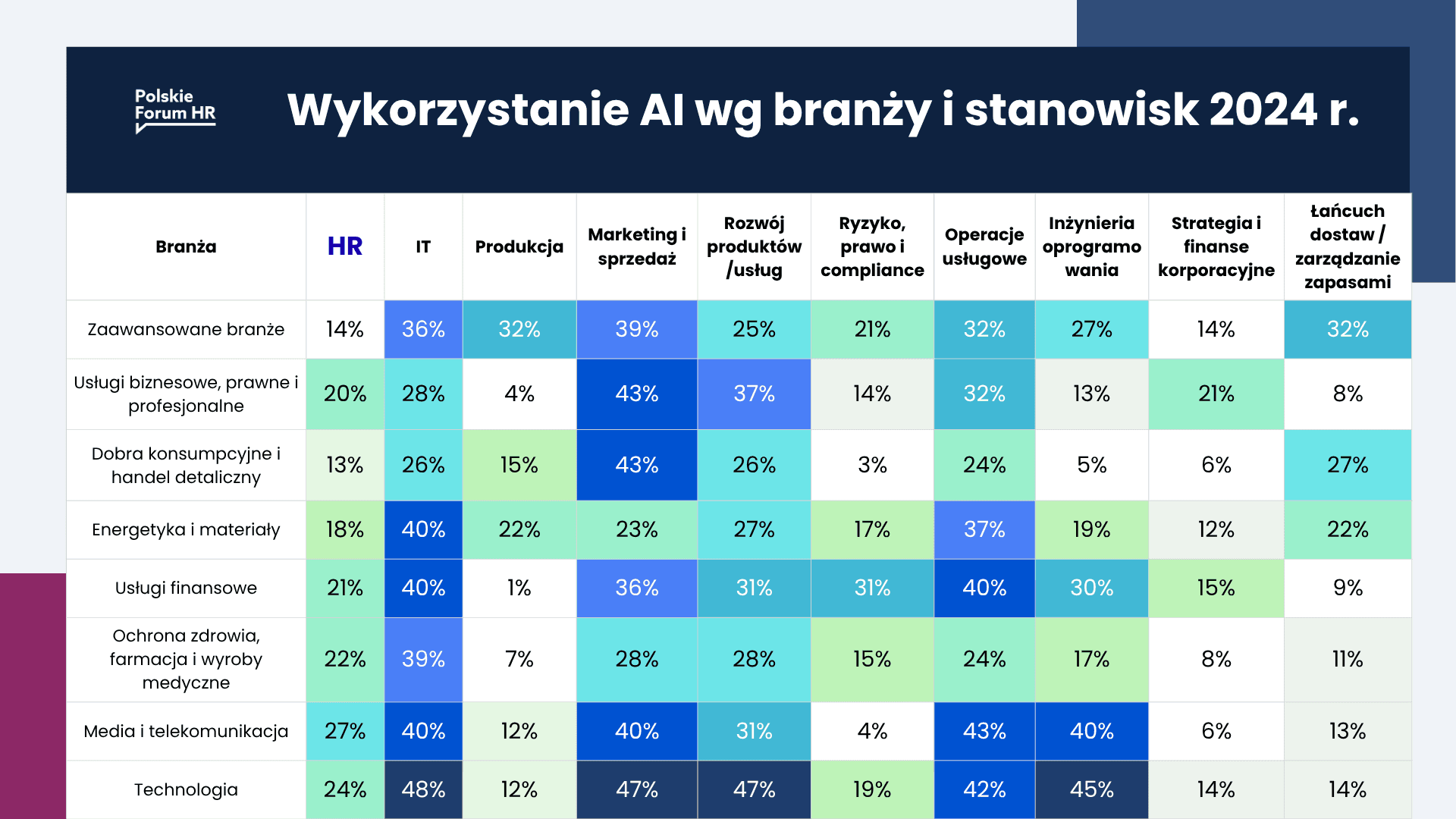
7. Where the Heart of Adoption Beats, i.e., Polish Industries Under the Microscope
Marketing, Sales, and IT as the Vanguard of Change: Regardless of the sector, these are the departments adopting artificial intelligence the most intensively. In the Technology industry, 48% of IT specialists and 47% of marketing and sales employees already use AI tools. Similarly, strong adoption in marketing is visible in Consumer Goods and Retail (43%) and in Business and Legal Services (43%). This explains why these departments are recording productivity increases of up to 50% globally.
Service Operations and Product Development: Sectors such as Media and Telecom (43%) or Financial Services (40%) are mass-basing their daily operations on AI. This is where the trend of automating front-line support and repetitive back-office processes will hit the fastest.
The HR Sector as a Rational Observer: The use of AI directly within HR structures ranges from 13% (retail) to 27% (media and telecom). HR in Poland is implementing algorithms gradually (mainly in recruitment and analytics), which gives it time to prepare for the role of arbiter and guide for other, more deeply automated departments.
REPORT PAGE>>>https://hai.stanford.edu/ai-index/2026-ai-index-report