Artificial intelligence in European companies 2025
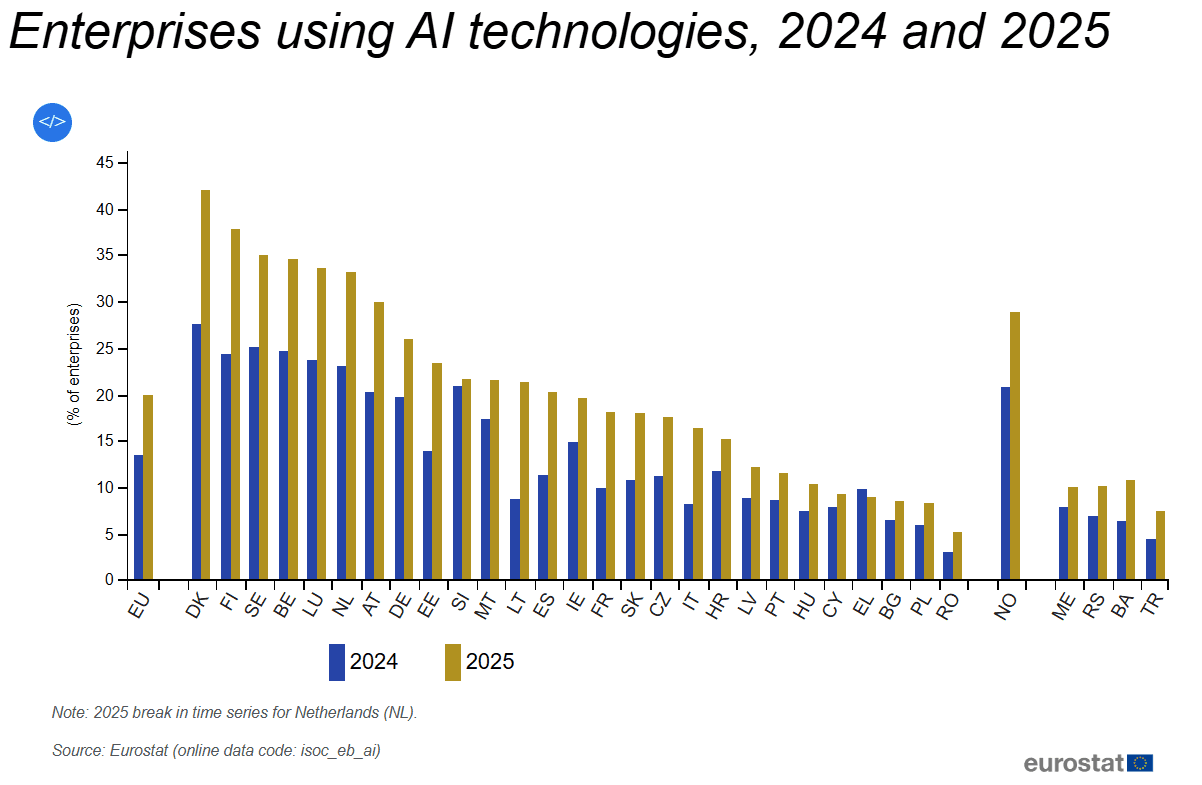
According to the latest data from Eurostat, in 2025, 19.95% of enterprises in the European Union will have used at least one AI technology. This represents a sharp increase of 6.47 percentage points compared to the previous year.

Artificial intelligence (AI) is becoming a key driver of the modern economy, providing businesses with better decision-making, more efficient production, and cleaner energy. According to the latest Eurostat data, by 2025, already 19.95% of enterprises in the European Union (employing at least 10 people) will have used at least one AI technology. This represents a sharp increase of 6.47 percentage points compared to the previous year.
The implementation of AI in Europe is progressing at a very uneven pace. At the forefront of digital transformation are the Scandinavian countries: Denmark (42.03%), Finland (37.82%), and Sweden (35.04%). At the opposite end is Poland, where this rate stands at only 8.36%, placing our country among those with the lowest level of AI adoption in the EU, alongside Romania (5.21%) and Bulgaria (8.55%).
Companies in the EU most often reach for technologies that analyze written language, that is text mining (11.75%). There is also a high demand for generating images, audio, and video (9.55%) as well as natural language technology (8.76%). In terms of business objectives, AI most frequently supports:
• Marketing and sales (34.70% of companies using AI).
• Organization of administrative processes and management (31.05%).
• ICT security, which is a priority especially for large corporations (47.51%).
The sector that absolutely dominates in the use of these solutions is information and communication (62.52%), while the lowest level of engagement is seen in construction (10.79%).
Despite the benefits, many companies are still hesitant to implement AI. Among the enterprises that considered this option but ultimately did not proceed, the most common barrier was a lack of appropriate specialized knowledge (70.89%). Companies are also concerned about the lack of clarity regarding legal consequences (52.52%) and breaches of privacy and data protection (48.83%).
The European Union has set ambitious goals under the "Digital Decade" program. By 2030, as many as 75% of companies in the EU should be using cloud computing, Big Data, or artificial intelligence. To achieve this, the European Commission plans to strengthen the continent's competitiveness by ensuring access to computing power for startups and supporting innovation in the public and industrial sectors. For countries like Poland, the distance to cover in the next five years remains enormous.