
EuroMotoBarometer 2026
In contrast to relatively stable Europe, the Polish automotive sector shows great pessimism, facing the risk of job cuts and a severe shortage of foreign workers.
General situation: Stability in Europe vs. pessimism in Poland
While the European automotive sector (employing approx. 14 million people) shows relative stability, Poland stands out from the rest of the continent as one of the most pessimistic markets.
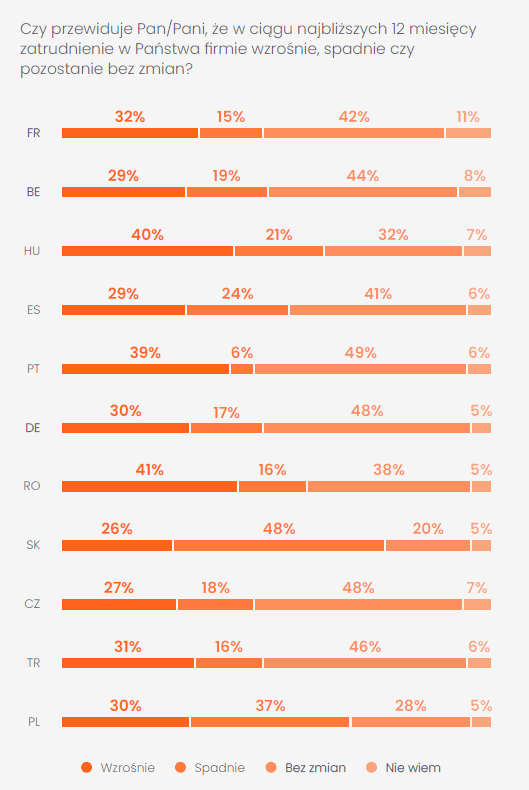
Europe as a whole: Sentiment is rather optimistic – 32% of companies plan to increase employment, 38% to keep it unchanged, and 24% to reduce it.
Optimism leaders: Romania (41%), Hungary (40%) and Portugal (39%) plan the most new jobs.
Pessimism leaders: Slovakia (48%) and Poland (37%) are the countries with the highest percentage of companies predicting employment reductions. The Polish market is entering a stage of high caution and selectivity.
Key HR challenges and recruitment barriers
The industry across Europe is struggling with technological transformation and cost pressure, however, different countries point to different key problems:
Pan-European problems: Shortage of skilled workers (46%), rising labor costs (43%) and high salary expectations (42%).
Regional specificities:
Poland: The main barrier is the lack of foreign workers.
Germany and Belgium: A shortage of specific skills is key.
Hungary and Turkey: High salary expectations are the biggest challenge.
Structure of foreign employment
Workers from abroad are key to maintaining production continuity, but their sources vary by country:
Ukraine as a pillar: Ukrainian citizens represent the most important workforce resource in Europe (an average of 29% of companies employ them).
Poland's extreme dependence: In Poland, as many as 63% of companies recruit workers from Ukraine, which shows that the domestic sector is heavily dependent on them.
Other directions: India, Vietnam and Moldova are also popular in Europe. In turn, Portugal more often relies on workers from Vietnam and African countries.
Automation and jobs: Fears vs. reality
Robotization raises major concerns about job cuts (60% of responses in Europe), but fear is not equally strong in all countries:
Greatest concerns: Turkey (69%), Germany (65%) and Poland (64%) – in these countries, the majority believe that automation will eliminate jobs.
Least concerns: Belgium (46%), Portugal (45%) and Hungary (38%) – here the prevailing view is that robotization will not reduce employment.
Conclusion: Experts emphasize that automation in Poland and Europe will not so much eliminate work as change its structure. Demand for simple tasks will decrease, while demand for specialists (technicians, operators, quality specialists) able to work in an automated environment will increase.