Where are you heading, logistics?
According to the ManpowerGroup report, as many as 43% of companies plan to automate warehouse processes, responding to strong cost pressure and the growing wage expectations of candidates. To cope with skills gaps and market volatility, businesses are turning to flexible forms of employment and the internal development of employees through upskilling (44%) and reskilling (39%).
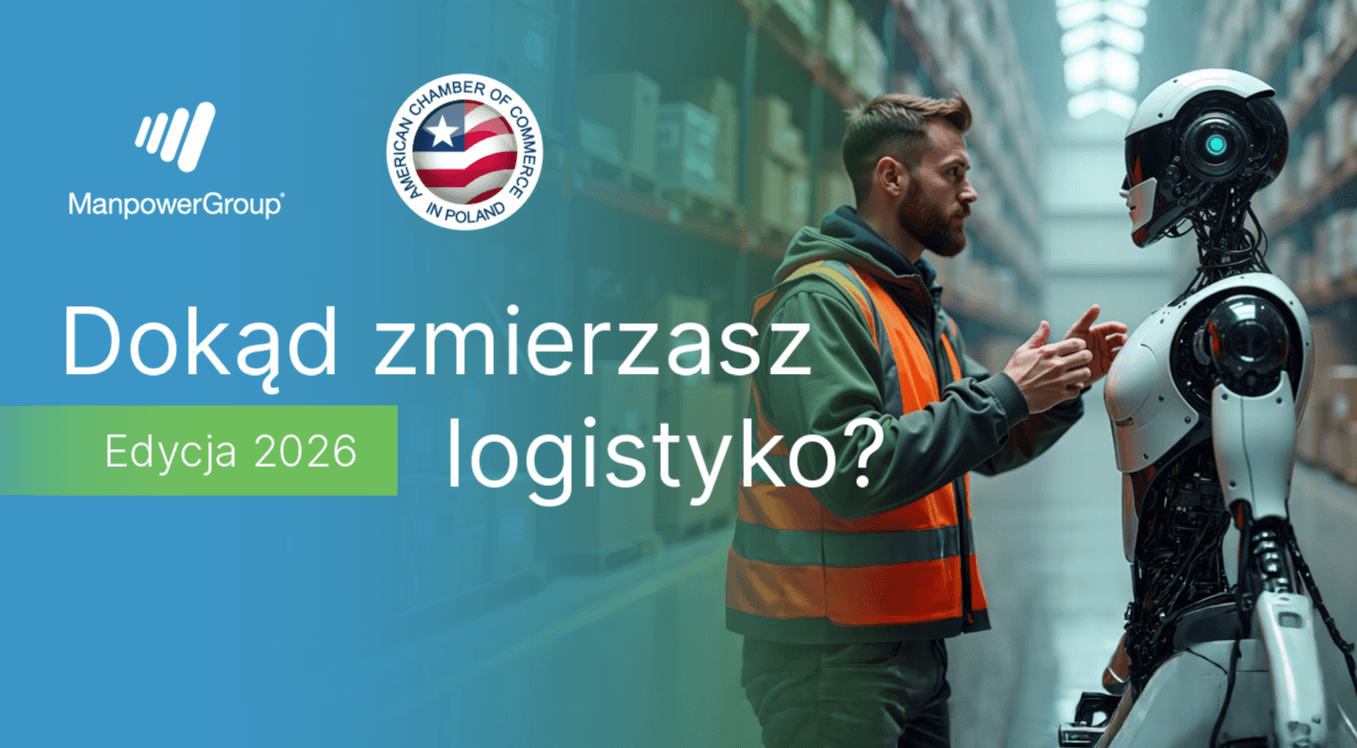
The new report from ManpowerGroup: Where are you heading, logistics? analyzes the current condition, challenges, and development plans of companies (with a particular focus on the logistics sector) in the area of process automation and human capital management.
Process automation plans
Automation is a key trend, and the lack of it in the coming year is declared by only 8% of companies. The areas that organizations plan to automate most frequently are:
Warehouse processes: 43%
Transportation processes: 31%
Sales processes: 22%
Production processes: 21%
The impact of these changes on employment strongly divides the respondents: 39% expect a decrease in the number of employees, while 38% do not foresee significant changes.
Challenges in the labor market and cost pressure
The logistics sector is developing dynamically, but is facing serious challenges, among which cost pressure dominates:
60% of respondents experience rising operating costs of staff employment (including recruitment expenses).
More than half of the companies point to the constantly growing financial and non-financial expectations of candidates.
Skills gaps and strategies to fill them
Employers notice large gaps in the skills of their current employees. The most visible deficits are in analytical skills (40%) and soft skills (36%).
In order to acquire the necessary skills, companies rely primarily on internal activities and the development of their own staff, and less frequently on external recruitment:
Upskilling (44%): training and raising qualifications in current positions.
Reskilling (39%): retraining and preparing employees for completely new roles.
Attracting talent from the market (approx. 33%): external recruitment.
Digitization and automation (28%): treated as a technological supplement to staff shortages.
Flexible forms of employment
In the face of the standard full-time approach, the importance of flexibility is growing. The most popular forms are part-time employment (42%) and temporary work (37%). Outsourcing (25%) and contracting (15%) are used less frequently.
For the majority of companies, flexible forms constitute a minority of the employment structure:
For nearly 40% of companies, they make up less than 10% of the total workforce.
For a similar group (approx. 40%), they fall in the range of 10–30%.
Main benefits of flexibility: Respondents point primarily to operational benefits – better alignment of resources with changing company needs, greater operational flexibility, and easier recruitment and retention of employees (as indicated by almost every second respondent).