
4.4 million people are covered by temporary protection in the EU
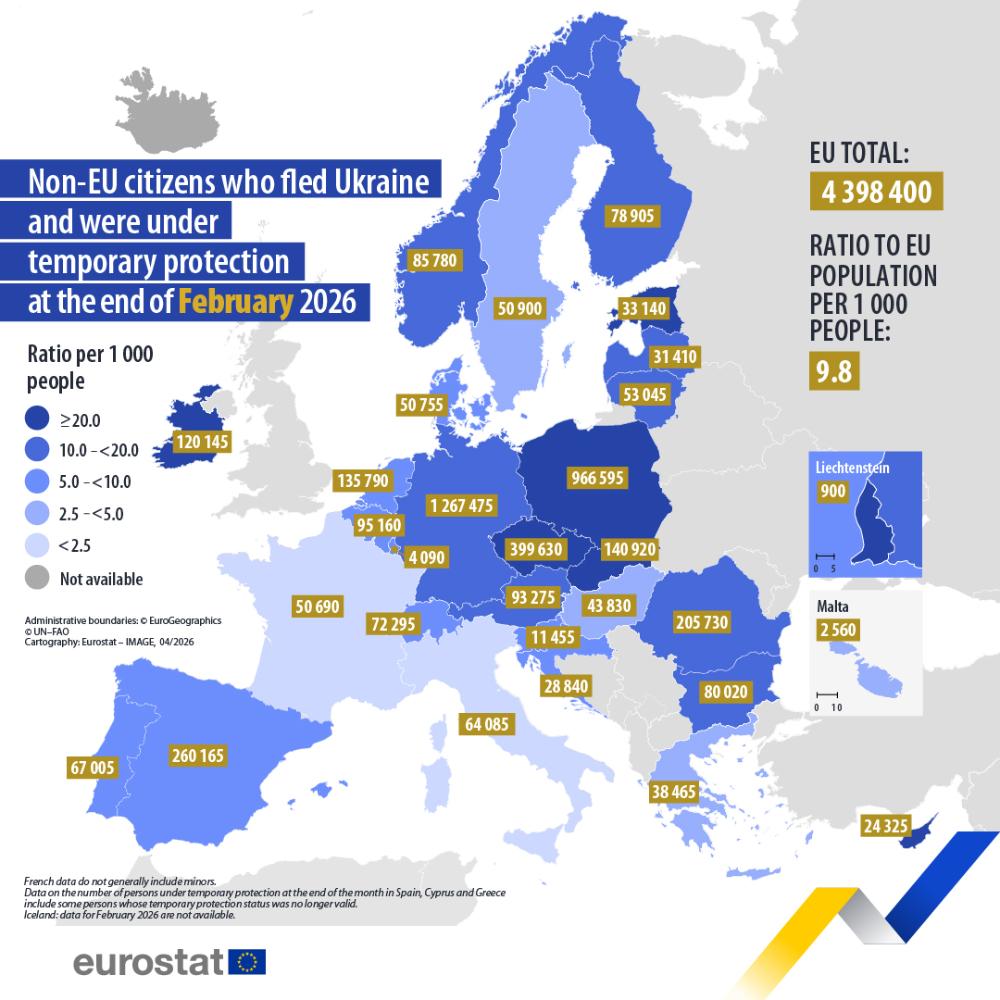
At the end of February 2026, 4.40 million non-EU citizens were benefiting from temporary protection in the European Union. Compared with January, there was a slight increase of 22,415 people (+0.5%).

At the end of February 2026, 4.40 million non-EU citizens were benefiting from temporary protection in the European Union. Compared with January, a slight increase of 22,415 people (+0.5%) was recorded.
Countries hosting the most refugees
The largest number of beneficiaries was in three countries, which together host nearly 60% of all people with this status:
Germany: 1 267 475 people (28.8% of the EU total)
Poland: 966 595 people (22.0% of the EU total)
Czech Republic: 399 630 people (9.1% of the EU total)
It is worth noting that the highest rate of people covered by protection per 1,000 inhabitants was recorded in Czech Republic (36.6), Poland (26.5), and Slovakia (26.0), compared with the EU average of 9.8.
Trends and demographics
The number of people covered by protection increased in 24 EU countries (most notably in Germany, the Czech Republic and Spain), while declines were recorded only in Estonia, France and Luxembourg.
Demographic structure of beneficiaries:
Adult women: 43.5%
Children and youth (minors): 30.2%
Adult men: 26.3%
Ukrainian citizens account for 98.4% of all people benefiting from this form of support.
Important formal information
Extension of protection: On 13 June 2025, the European Council decided to extend temporary protection until 4 March 2027.
Definition: Temporary protection is a procedure activated in the event of a mass influx of people who cannot return to their country, aimed at easing asylum systems and providing immediate assistance.
Notes on the data: Statistics for France usually do not include minors, and data from Spain, Cyprus and Greece may include people whose protection status has formally already expired.